

Some mornings, this newsletter has me thinking about Homer Simpson’s alcohol-fueled car fantasy. In his daydream, Homer’s at the gas station, pumping “one for you,” into the fuel tank and “one for me,” into his mouth.
What I’m saying is, there are certain “one for you” topics that really respond to current customer demand. You can call that “audience capture,” but I just see it as sensible curation. Plus, I’m a lot like the audience, most of the time. Thankfully, we tend to be interested in the same subjects, so “one for you” comes easily. Then there are the “one for me” topics that don’t really do numbers on my end, but happen to be an honest reflection of certain preoccupations, like 2023 House of Strauss Muse Brock Purdy. At the very least, these occasional flights of fancy let you know this site isn’t written by AI.
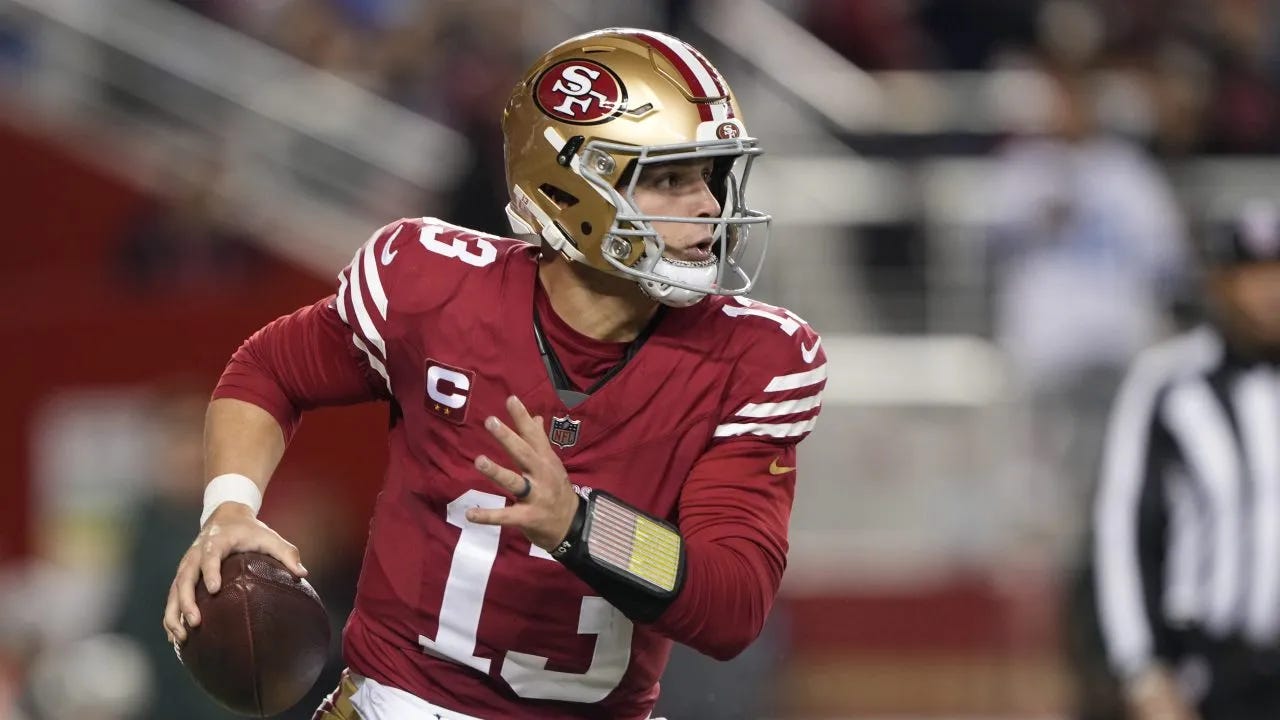
Purdy mostly lives in that “one for me” category. I’m fascinated by his hotly debated career arc, but nobody looks to me as any kind of NFL expert. If I go on local radio and make some thoughtless guy-on-the-couch remark about the Golden State Warriors it can get aggregated as, “WARRIORS REPORTER SAYS,” even if I’ve long since retired from that life. If on that same radio station I unspool some 49ers theory I’ve researched for weeks, nothing will happen. And that’s just fine.
There are a couple of you, however, who reached out and demanded I write about Brock Purdy’s lofty showing in recently constructed quarterback stats. So I guess this piece is “one for us.”
Our guy Nate Silver has come out with QBERT and what do you know? Brock ranks first in 2026 “Adjusted QBERT.” The New York Times just came out with their own “QB Index,” cheekily introduced as “A perfect QB stat everyone will love, and no one will disagree with.” Purdy might be the main reason a lot of people will hate and disagree with the ranking: He’s tied for second in QBI. Purdy’s 9-game showing in the 2025 season also ranked him second in advanced analytics standby QBR, right behind Drake Maye.
Meanwhile, in the non-analytics determined rankings, Purdy rates much lower. In the NFL survey-based Mike Sando list, he’s 11th. In the ESPN survey-based rank, he’s outside the top 10. Kyle Shanahan buddy and booster Chris Simms ranks Purdy 17th at NBC.
As Alex Sherman of CNBC frames the forever Brock Purdy status conversation:
The Brock Purdy debate is the same every year.
{Reads through analytics, Purdy No. 1-3 in every advanced statistic.}
"I'd say ... fourteenth best quarterback."
If a quarterback is “overrated” in every advanced metric, perhaps he’s not overrated. He might even be plausibly underrated. So, before Purdy is fed to Myles Garrett and the REM-ready Rams in Australia, let me list the reasons for his general dismissal relative to production. A lot has to happen for a player’s numbers to be this out of alignment with his reputation. In this piece, I’ve comprehensively compiled all the factors.
1. Draftism
This is the big one. Brock Purdy was, famously, the last pick in the 2022 NFL Draft. It’s all part of his branding, so it’s a sticky designation. “Draftism” is real, across sports. You’d think we could move on, but that’s not how it works. If you’re a late pick, NFL analysts look for confirmation of that prior. If you’re a top pick, NFL analysts look for confirmation of that prior.
2. “The Avengers”
I blame/credit HoS guest Nick Wright for this one. Nick branded Purdy’s surrounding 2023 Niners cast “the Avengers,” an embarrassment of talent riches that could plausibly explain the 262nd pick’s unexpectedly spectacular numbers.
Future Hall of Fame running back Christian McCaffrey gets most of the credit in this category. In 2023 MVP voting, CMC finished 3rd to Purdy’s 4th. The threat of McCaffrey doesn’t explain away Purdy’s historic success on 3rd down, but that narrative worked for a lot of people, especially since the 49ers had a down year in the 2024 season CMC mostly missed. McCaffrey has fallen off a lot since his peak, yet Shanahan still spams his usage, but I digress.
One 2023 narrative for Purdy critics was that he was “dink and dunking” to these superstars who’d then reel off yards after catch (YAC). Since YAC was known to be a calling card of the Shanahan offense, this made some superficial sense of an otherwise confusing phenomenon. It wasn’t statistically true then, and less is true today, but there’s always a lingering effect from an initial frame. Many of these roads lead back to “draftism”: We must make sense of a player who wasn’t supposed to be this good.
3. Shanny Ball
Speaking of Kyle Shanahan’s strategy, a lot of his offensive success is owed to a contrarian focus. Kyle wants his quarterbacks to rip the ball in that valuable middle of the field, interceptions be damned. I believe that all the NFL talk about this genius mysteriously “scheming guys open” obscures how the strategy really plays out: The QB throws the ball into highly-trafficked hell, and the numbers work out on balance.
As I’ve established, Brock Purdy’s main value proposition is uncommon success in that 10-20 yard “intermediate zone.” Brock relies on arm strength less than other quarterbacks because his specialty is a looping curveball that sails over the outstretched arms of linebackers. This throw is why current 49ers Defensive Coordinator Raheem Morris refers to Purdy as “the layer king.” The ball is “layered” to the receiver behind the linebacker and in front of the safety.
It’s a risky pass, even if Purdy happens to be the best at it. Brock has an extremely high 4.64 percent interception rate on these intermediate zone attempts. Based on old school turnover-avoidant football wisdom, he should stay out of that danger zone. But look at the numbers in totality. Purdy’s intermediate throw is completed at a spectacular 67.5 percent rate for a ridiculous 12.0 yards per attempt. While it’s accounted for 16 interceptions, that’s actually well worth it for the 24 touchdowns it’s also yielded. One reason Kyle “succeeds” with his quarterbacks is because he optimizes for what actually works — moving the ball down the field — sometimes at the expense of player reputation. The offense scores, Kyle gets praise for winning, and the quarterback gets crushed because people overreact to interceptions.
4. The Other QBs
Shanahan gets a lot of credit for Brock Purdy’s out of nowhere rise. Some of that is related to how other 49ers quarterbacks have performed. When Purdy went down in the 2025 season, the 49ers managed to go 5-and-3 with Mac Jones playing decent ball. Jones was less than elite, mostly because he can’t really move, but he was above average in suboptimal circumstances.
Mac, who made a Pro Bowl as a rookie for the New England Patriots, isn’t the most shocking of reclamation projects. Still, his winning record helped further the narrative that Shanahan controls these QBs with far greater command than he drives his Tesla.
Ever since Brock popped, there’s been a Shanny halo with quarterbacks. Even if former Brock backup Sam Darnold left the 49ers, Shanahan’s influence is partially credited for his success afterwards. Personally, I don’t believe that Darnold is such a great quarterback, though he’s commendably rebounded from past lows. The Seahawks were arguably the best defense of the last quarter century, but again, I digress.
More pertinent to the Brock analysis is Jimmy Garoppolo, who had similar limitations to Mac Jones, and crushed in basic quarterback stats like “passer rating.” Oft-injured Jimmy G fell apart after his 49ers run, validating the Shanny Halo Effect. I don’t believe Garoppolo’s prime years production (average, according to QBR) should be used as an indictment of a quarterback who’s since greatly surpassed that production, but as previously mentioned, I’ve little purchase on the NFL media conversation.
5. NFL Statistical Stone Age
As I’ve said, the NFL is our most complicated game, analyzed via our dumbest math:
This is charming, in a way, but also sort of insane? In other sports, we’ve accepted the idea that the “eye-test” is often bunk, and must be checked against statistics. As I’ve said, the NFL is stuck in a pre-Moneyball stone age. Because of that, people who know infinitely more about this sport than I do produce rankings that I’ve got good reason to doubt.
I don’t buy the excuses for why the NFL status quo must be so.
So why do I believe that chaotic, violent football shouldn’t be so different? Why do I assume that the most obsessive sports culture almost happens to run on unfalsifiable and thus untrustworthy confirmation bias?
My defense, in a word, is “baseball.” The Moneyball era revealed that the baseball professionals, for all their granular knowledge, had an inability to separate statistical signal from noise. The dumbed down version of this story is that baseball men assumed batting average meant more than it did and that on base percentage meant less than it did. Scouts believed in the ineffable quality of a “five-tool player” versus prioritizing what the athletes actually produced. So why would the NFL be any different?
How is this Purdy-pertinent? Well, he keeps crushing in advanced numbers that few in the NFL seem to care about. Again, as I’ve noted, interceptions are highly overemphasized in NFL media discourse. Sacks, which aren’t listed in the top line of a quarterback’s statistical playoff card, are underemphasized.
I’m not saying that the nerds have it all figured out and there’s now one solitary trustworthy ranking like QBERT. I’m instead saying that the advanced numbers tend to agree on Purdy because they’re all generally measuring the same quality: One’s ability to move the ball down the field as the situation demands. For whatever reason, football developed a lot of trusted data points that are almost orthogonal to that consideration.
6. Injuries
This is the most legitimate slight of all the issues brought up against Purdy in NFL media. He played 9 games last season, and got dinged up throughout the preceding 2024 campaign. His elbow was obliterated in the 2022 NFC Championship by then Eagle Haason Reddick.
One major reason for why Josh Allen is “Josh Allen” is that quarterback’s remarkable durability. Allen’s size and strength aren’t merely useful on the field. As with LeBron James in the NBA, his physical advantage doubles are armor. Allen hasn’t missed a single game due to injury since the 2018 season. He’s a tank. Brock Purdy is not a tank. It’s fair to have less belief in someone whose availability is in doubt.
7. “Physical Traits”
This overlaps a bit with the injury concern. You hear this knock invoked with Purdy and it’s true, to a certain extent. Brock has a mediocre RAS score of 4.51. At roughly six feet tall, he’s short for a quarterback. We don’t have objective arm strength measures, but the rep on Purdy is he lacks a cannon.
Purdy does, however, have one elite trait. For whatever reason, Brock has a super fast 1.61 second 10 yard split, even if his 4.84 40 yard dash time is just OK. This attribute allows Purdy to scramble away from trouble like, as tight end George Kittle puts it, a “Jesus Christ lizard.”
So those are my seven factors and I might even have missed a few. Let me know if there are any others. Happy NFL season, folks.
BACK TO THE ORIGINAL MUSE! THANK YOU ETHAN FOR YOUR HARD 4 AM WORK!
Excited for another year of injuries and losing to the Seahawks lol
I think Point 4 is among the strongest counter arguments to the Purdy naysayers. Sure Mac Jones was solid, but the offense clearly hit another gear once Purdy returned. I felt it was obvious from the eye test that Purdy made the offense far more dynamic, but it bears out in EPA as well