

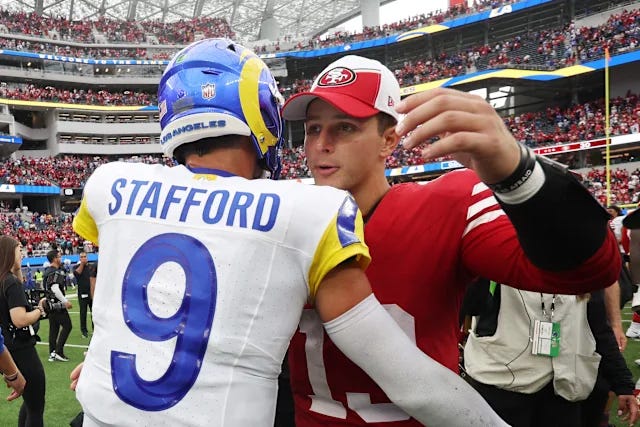
With NFL Training Camp suddenly here, the league-sourced top-10 lists that get fanbases whining are out. More so than the other sports, football produces a lot of insider-informed, prestige media-published rankings. One reason there’s a demand for this is the sport is known to be complicated. We get that the professionals grasp football on a level that we never will, so there’s an inherent curiosity over how their views might differ. Here’s one such quarterback ranking from ESPN’s Jeremy Fowler.
And here’s one blanket rebuttal to such lists, posted by sports writer Scott Kacsmar:
I’ve been very consistent for a long time about not overreacting to the last NFL season in ranking QBs. That’s why I had Manning, Brady, Brees, Rodgers, Ben as the top 5 for half a decade in the 2010s. Once a QB is established, they rarely play significantly different skill wise. Any statistical gains or losses are usually some combo of health, teammates, change in coaching, schedule, etc.
Kacsmar is correct, but the wrinkle I’d add is that NFL culture doesn’t overreact to the latest stats. In my view, they overreact to what they think are the stats, like how pre-Moneyball baseball analysts made assumptions on the basis of RBI variance and what not. Even more confounding, NFL culture also reacts to what they think the stats should be, on a hypothetical neutral field.
The Fowler list, love it or hate it, has almost no correlation to how statistically efficient NFL quarterbacks were in recent seasons. This is common among such lists and serves as built-in gripe for us whiners in the Bay, and those whiners out in Green Bay, who respectively point out that Brock Purdy and Jordan Love get judged differently than quarterbacks who play less efficient ball. Since becoming starters, Purdy and Love have been top 10 in QBR each season, but are generally less respected in rankings relative to their output.
Oh well, that’s life. Purdy and Love will have hundreds of millions in earnings to console themselves with. But I find the whole dynamic rather curious. This is America’s most popular sport and it broadly doesn’t believe in data. This is charming, in a way, but also sort of insane? In other sports, we’ve accepted the idea that the “eye-test” is often bunk, and must be checked against statistics. As I’ve said, the NFL is stuck in a pre-Moneyball stone age. Because of that, people who know infinitely more about this sport than I do produce rankings that I’ve got good reason to doubt.
Since fandom will both make you a biased homer, and also lead to analytical discoveries, I want to dive further into the Curious Case of Brock Purdy. I’m not going to argue against his place in rankings, seeing as he missed nearly half of last season. Instead, I’ll explain why his analytics dominance tells you something about a) what 49ers coach Kyle Shanahan values and b) what NFL conventional wisdom doesn’t value enough.
Personally, I think passer rating is a very flawed stat, but you see it referenced a lot by old school football types. Brock Purdy is a mere 147 passes away from the minimum threshold for the career passer rating list. Barring some massive downturn, he should then be number one, looking down at all the greats. Purdy’s career passer rating is 104.0. Two-time MVP Lamar Jackson currently sits atop the list at 102.2, ahead of Aaron Rodgers, Joe Burrow and Patrick Mahomes. The placement of those names makes sense to people in a way Purdy’s will not. The fly in the ointment, as far as Brock’s reputation is concerned, is that former 49ers quarterback Jimmy Garoppolo is currently 9th on this all-time list.
I’ll note that Purdy also crushes in the nerdy metrics like DVOA and QBR, so this isn’t a pure quirk of an outdated holistic stat. With Brock at the helm, the 49ers consistently have an elite passing attack. Something is happening underneath the surface of the game and it’s largely missed by traditional counting numbers like yards, touchdowns and interceptions. It’s partially vaunted genius Kyle Shanahan, just not in the way many assume. I’ve heard the narrative that Shanahan’s superior schemes leverage play-action to boost QB production. After looking into the numbers, I don’t see evidence of this. Brock Purdy excels on 3rd down, when there’s no credible running threat.
So what is it? I’d argue that the production is downstream of not just a consistent ability, but also a contrarian choice. Brock Purdy likes to rip the ball in the intermediate 10-20 yard area, often middle of the field, interceptions be damned. As I’ve argued, interceptions are overrated by NFL pundits. A pick gets received on social media as a MASSIVE QUARTERBACK ERROR, while the triumphant defense does their choreographed celebration sprint to the cameras. To be clear, an interception isn’t good, but there are 10-12 drives in a game. What mostly matters is moving the ball downfield. This is why, though Kyle Shanahan might be a control freak, he’s a big believer in making his quarterback risk picks.
With that in mind, here are Brock Purdy’s career numbers in the crowded 10-20 yard intermediate zone area of the field.
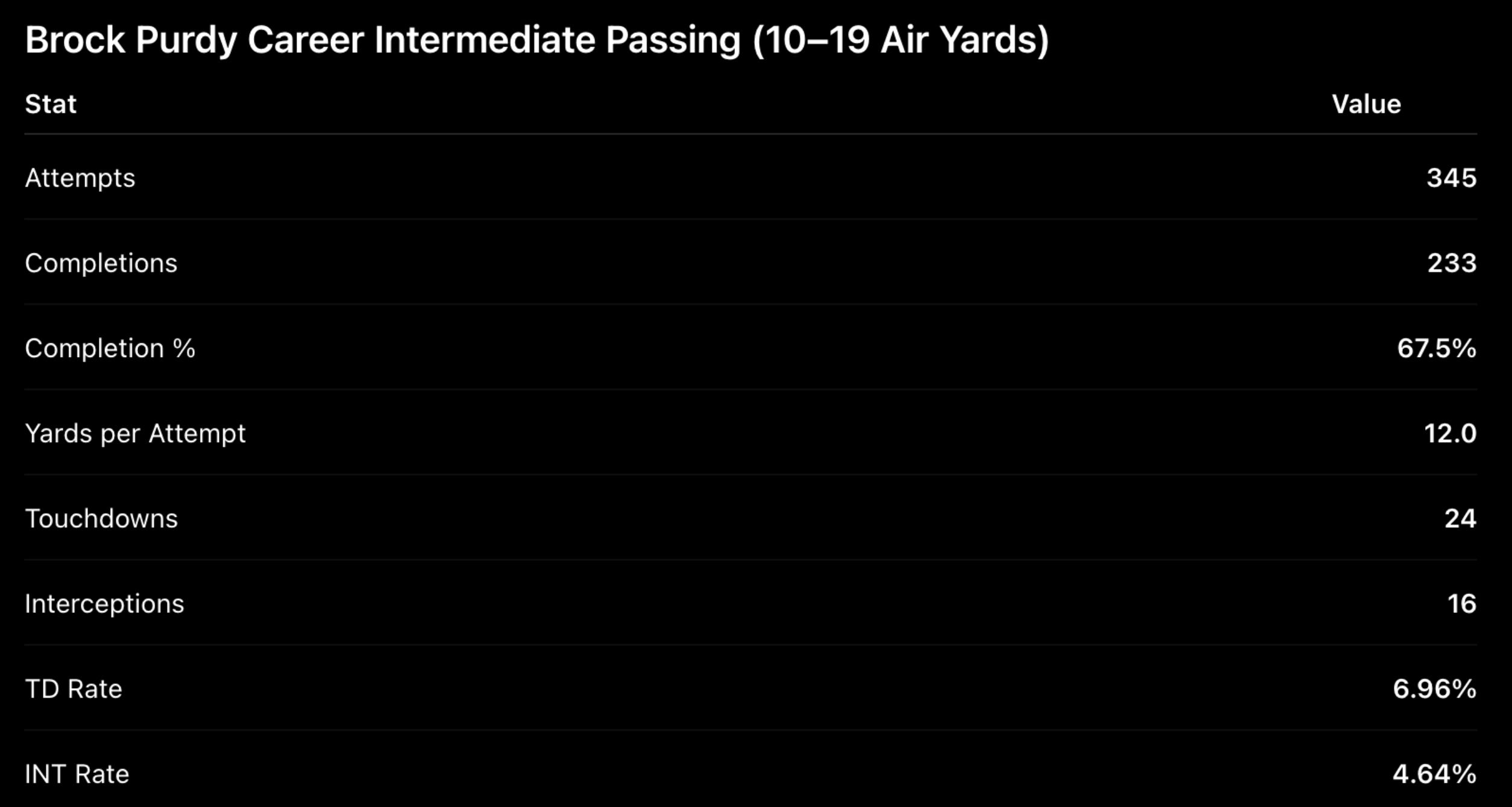
This production is ridiculous. You shouldn’t be able to complete 67.5% of your passes for 12.0 yards per attempt on throws at this depth. Brock’s worst completion rate on intermediate throws, in any season, is a fantastic 64.7% from last year.
Compare Purdy’s career stats to Matt Stafford’s numbers on intermediate throws in this past MVP season.
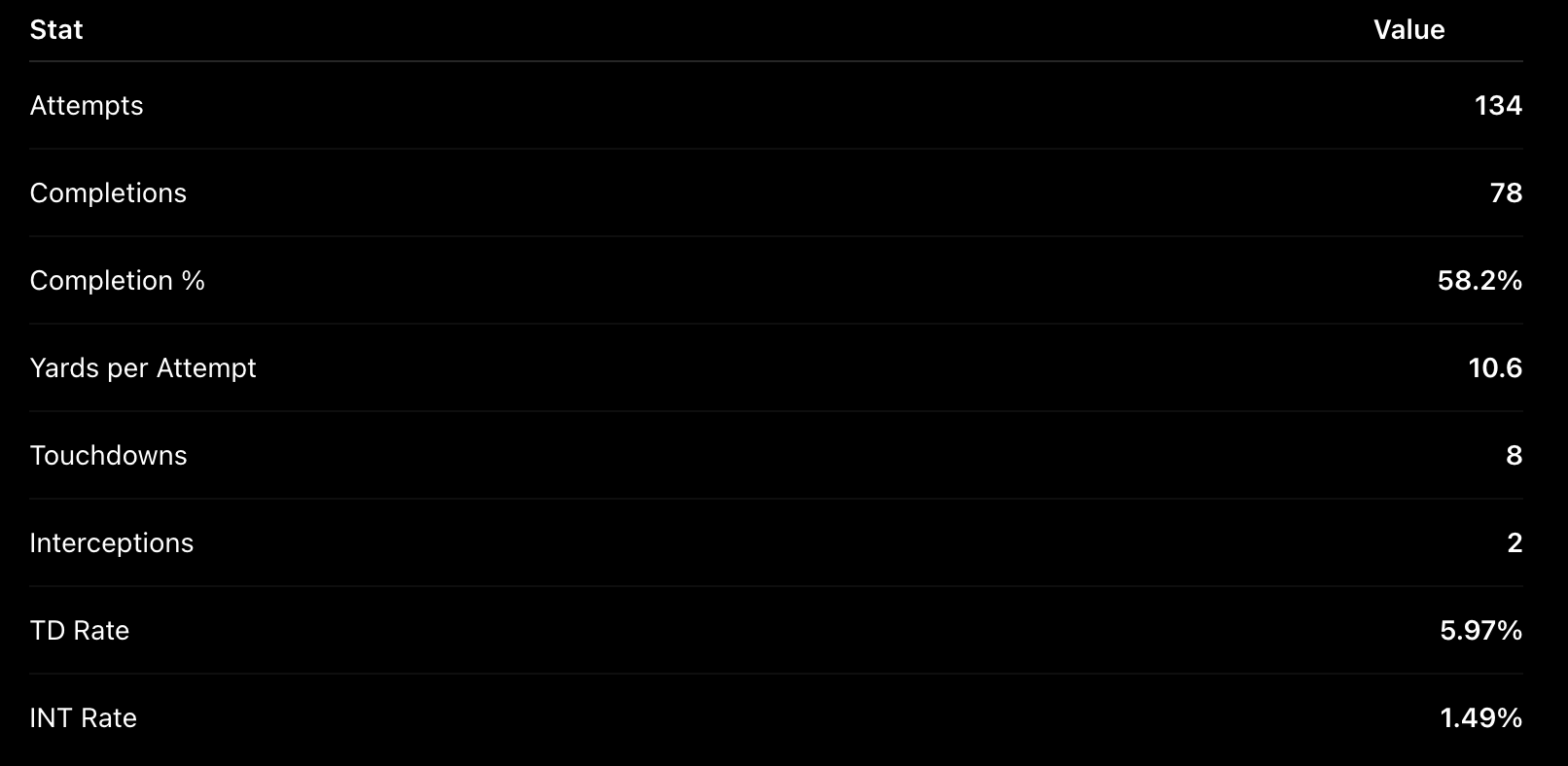
This is no slight to Stafford, because 58.2 percent isn’t a terrible number and this is great production when we’re talking attempts between 10-20 yards (If you’re wondering how Stafford produced such gaudy stats overall, he threw for 11 touchdowns and only one interception on deep attempts). For another point of contrast, because Baker Mayfield and Purdy are often debated in rankings, in Mayfield’s Tampa Bay seasons, he’s managed 56.4% on intermediate throws for 9.6 yards per attempt.
This is Brock Purdy’s superpower. Yes, he’s decent at other aspects of the game, like scrambling and the occasional deep pass. But this is Mr. Irrelevant’s secret sauce, and biggest reason for why advanced quarterbacking metrics are more favorable than his overall counting stats.
To make a fanciful cross-sports comparison, Brock Purdy is a baseball player I’m going to name Triples McGee. He has a level swing and hits a lot of liners, which is very old school, but his batting average isn’t that impressive. He doesn’t knock many home runs. He walks a lot, though (perhaps we can compare to Purdy’s NFL sack avoidance). He sets the record for triples in a season and hits his share of doubles. There’s no clear way to grasp how Triples McGee compares to a top tier slugger absent helpful metrics like OPS.
Purdy accomplishes his “triples and doubles” productivity, in part, because he’s the master of the layered throw over linebackers. As you can glean from the numbers I posted, and from the clip I just included, success in this area comes with a lot of risk. Purdy’s interception rate in the intermediate zone is roughly twice the NFL rate on all attempts. If you’re an old school ball control coach, you don’t accept this. If you’re Kyle Shanahan, who loves gashing that valuable middle of the field, this is the cost of doing business. Purdy plus (to a lesser extent) Garoppolo and Mac Jones have almost functioned like Kyle’s reputational crash test dummies. For the greater good, they suffered throwing into heavy traffic.
My point isn’t to argue that Brock Purdy is underrated, or that he’s credibly an all-time great, but instead to ask: How many NFL analysts even know about the extent of this intermediate zone success? How many have opinions about it? How aware are they of the risk/reward here and the way it compiles in the aggregate? I’m sure that some are, but how many are?
You can grind tape all day, understand personnel groupings on a PhD level, and still lack the ability to accurately gauge cost/benefit. That’s my main issue with conventional NFL analysis. It’s not that the professionals know so little. It’s that they either lack, or reject, a data-based ability weigh all that they know.
In the case of Purdy, the conventional wisdom is onto something in explaining Brock’s success with a dismissive “It’s Shanahan.” But because data isn’t respected in this sport, I’d argue there’s a dearth of popular exploration into why it’s Shanahan and how that meshes with Purdy’s skill set.
I can speak more to the Bay Area experience, but this happens with other quarterbacks who perform better than the NFL culture expected. You’re just supposed to “know” that the counterintuitive outcome occurred via some mysterious process that confirms our priors. We understand the idea of a genius HC helping players succeed, so we say, “It’s the coach’s scheme,” the way ancient people would credit weather to the gods. This could be the story, sure. But if this is the explanation, and it’s divorced from data, it isn’t much of one.
As I've said for a million billion years, sports statheads desperately need to take some graduate philosophy of science classes. It's crazy that actual research physicists are more humble about their truth claims than, like, Seth Walder. Every quantitative indicator is subject to its own corruptions, and how you choose which metrics to elevate is always a value-laden process. Which isn't an argument against statistical analysis, but it is an argument in favor of epistemological modesty, which I don't see in someone like Walder or Bill Barnwell.
And Kacsmar is a funny reference here because he's notoriously subject to the dictates of his own resentments; he has insisted for years that Josh Allen is not a good quarterback, and has only been forced to by events in the last couple of years. Why? Because he was a very loud Allen skeptic in his draft process, and he's mad that Allen proved him wrong. Lots and lots of stat guys are subject to those corrupting influences.
The only stat is wins