

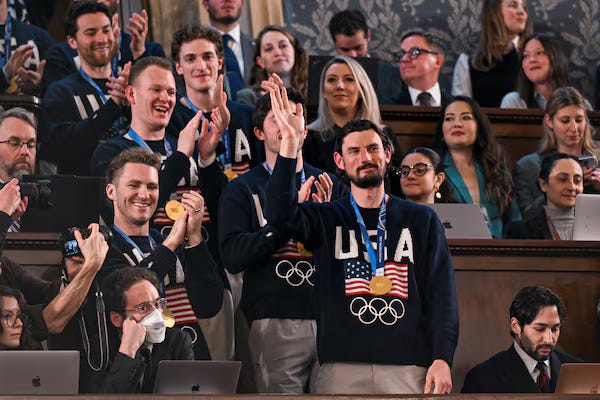
This post at The Athletic is making the rounds, drawing criticism on the right. I think it’s easy to mock this column, but also believe it captures, albeit myopically, a lamentable problem with modern public life.


I certainly can’t disagree with this potentially related Nate Silver take.

I don’t remember a lot from college lectures, save for maybe two distinct mind expanders. The first was that, in Ashkenazi Jewish culture, it is customary to interrupt (Linguistics professors could make such points in those days). That one helped me make sense of my father. The second was the tale of a hypothetical farmer from my class on Globalization.
There’s a farmer, you see, and he has no other real ambition. He just wants to eke out his subsistence living in his developing nation, as generations had before. He’s out in the sticks, far from civilization’s demands. He tills his land, collects his crops, takes them to market. Nothing should disrupt his life, save for the weather, because nothing traditionally has. He grows food and the people in the area wish to buy that food. He had abstained from the modern world, eschewing its promise of “progress.” What news of international import could possibly impact a man who makes a meager living from the dirt on up?
Well if he’s a 1990’s Mexican corn farmer, it’s NAFTA. After the North American Free Trade Agreement was signed, Mexico was opened up to American corn, which was produced at scale and subsidized by our government. The price of corn collapsed in Mexico, which was good for a lot of Mexican consumers, but not so great for our farmer. Now nobody at the market wants his corn, at least at levels that might support his subsistence living. A lot of family farms failed back then, unable to keep pace in a race they didn’t know they were running. Now our man is completely out of a job, and desperately moving to the big city to find one. Globalization found this guy where nobody was looking and pulled him into its rat race.
My point isn’t to criticize globalization or even to pity the farmer, though I do feel sorry for him. It’s that faraway forces beyond our control can disrupt our theoretically contained lives. We might not choose to participate in a trend, but the trend might choose to participate in us.
Strange as it sounds, I thought a lot about that farmer in 2020. As a naive basketball reporter, I assumed I could abstain from politics at my discretion. When I joined the Athletic in 2018, I largely stopped tweeting content other than story links. The social media discourse had gotten ugly during Trump’s first term, and covering Kevin Durant was enough stress for me. Keep it basketball, work hard, and what could go wrong?
Then COVID happened and society went mad in ways I hope are forever inconceivable to my kids. After George Floyd, the massive trend was upset over race and policing in America. Almost everyone in my industry posted a Black square on social media to signal solidarity with racial justice.
I did not post a square. I assumed that was fine? I certainly wasn’t criticizing others who posted a square. But it was not fine, apparently. “Silence is violence” was a phrase that, while completely insane, was en vogue back then among the educated.
Peers and colleagues noticed my lack of a square, with a few airing the injustice on social media. I was getting attacked, murdered even. A couple sports writers contacted me in private to pressure me over my intransigence. They knew my heart was good, so clearly I’d want to correct this obvious oversight. They wanted me to know that observers might get the wrong idea about me. I wasn’t a conservative (that part was true), after all.
The irony is that the craziest people, those attacking me online for square-lack, were in a way, the most correct. I did harbor misgivings about that moment. I did think it was a hysteria. I didn’t even hate the police! As a then resident of Oakland, I kind of thought we needed more policing. My lack of participation wasn’t just a dearth of participation. It did indeed betray an absence of faith that was suddenly impossible to hide. I’d been discovered and had to either represent myself clearly and out loud, or suffer ostracization without a defense. I swear life was exactly that stupid in those times.
And so I wrote more about thoughts I’d previously kept to myself, because, as I saw it, I’d been forced to choose that or lie. It turned out fine and I’m glad it all happened, but also, how absurd. Here I presumed I could just keep taking my crops to market forever, writing about basketball without getting criticized ideologically, but the modern oversocialized world had other plans for me. Participation, one way or another, subtly or overtly, was mandatory.
And it’s with that lens I view Jerry Brewer’s take in the Athletic on the SOTU-attending USA men’s hockey team. He writes:
In normal times, this would be an obligatory celebration for a championship team. They take presidential calls. They party too hard. They visit Washington and stroll through the corridors of power.
But this isn’t a neutral climate. This isn’t a neutral president. And in a nation this polarized, the proximity carries weight whether the players are being intentional or merely naive. America no longer experiences these rituals in the same way, and it may never again.
I could make the case, as others have, that Brewer sees his own ideology as “neutral.” While I find that aspect annoying, I can’t necessarily disagree with the words here. Yes, in the past, nobody sane would fault the hockey team for these appearances. Yes, we’ve stopped agreeing that this ritual is apolitical.
The hockey team neither created this divide nor possessed a shrewd political instinct to wrap their victory in a partisan glow. But when they stepped so early into that embrace, they narrowed their moment.
Yeah, but here’s the issue. Even if I believe that these hockey players just happen to be (gasp!) conservative, neutrality wasn’t an option for them. When Donald Trump extended that invite to the SOTU, in real time, the choice is either to affirm or humiliate him. You can criticize the team, as Brewer does, for so enthusiastically embracing the president, but the point is that, even if these boys aren’t interested in politics, politics is interested in them.
Trump wants their presence, for his own political reasons. Trump’s enemies want the hockey team to shun Trump, for their own political reasons. Accept Trump and you’re a hero to the right; reject him and you’re a hero to the left.
The surrounding culture created a binary choice. I agree with Nate Silver that the people who politicize everything are deeply annoying, and yet I’ve no idea on how to reverse the reality that so much of public life now carries a political valence.
Most of us, including and especially my Gen X friends, want to go back to the old days. My Zoomer friends might not recall it, but there once was a vast apolitical cultural space in this country. It was called, “most of the 1990’s.” And while I pine for that reality, I do not anticipate its return, even after Trump. Brewer is both participant and observer of the condition he describes when writing, “America no longer experiences these rituals in the same way, and it may never again.”
This hockey story is the perfect illustration of why the mainstream media is so nauseating. This should be nothing but a happy, unifying moment, but the most neurotic, joyless, miserable scolds imaginable have tried to imbue as much negativity into it as possible. Because heaven forbid anybody out there not be as miserable as they are.
You really can't hate the media enough.
The Athletic is running daily puff pieces on Eileen Gu and hit pieces on the USA men's hockey team. The media's game has become bad faith enragement in lieu of honest journalism. Wading into the comments is like visiting another world. Am I wrong for thinking that China and Russia are running thousands of accounts to post controversial or highly politicized comments on all of the main media platforms? Tin foil hat time, but is the media now unwittingly aligned with the USA's enemies (internal and external)? One posts rage bait and then the other fans the flames with comments, drawing in people from both sides to double down on their political positions. This is not healthy for the country.
Similarly unhealthy are the Mao-style forced fake confessions which have become all the rage. I expect at least one gold medalist to be compelled to offer some kind of phony apology. Ethan mentioned the black square which became a referendum on whether or not someone was "with us or against us." I can't think of a more performative and useless gesture than posting a black square on IG, but there we were. More recently, small businesses were compelled to post their explanations for why they didn't participate in the phony "general strike" a few weeks ago. Small businesses obviously need to stay open to make money so they can pay their staff! And yet they had to kneel before the mob to explain that they support "the cause" (whatever that is) so that they didn't get flamed on socials. In my town, one business stayed open and did a fundraiser for an immigrant charity. That wasn't enough for the chronically online crowd and they demanded that the business post receipts of the donation and even then people still complained. For the long term viability of our society (hyperbolic, I know) this has to stop.