

Following the blight/feat that was Bam Adebayo’s 83 point game, our guy Wos has a theory:

And our guy Spike has a theory in response:
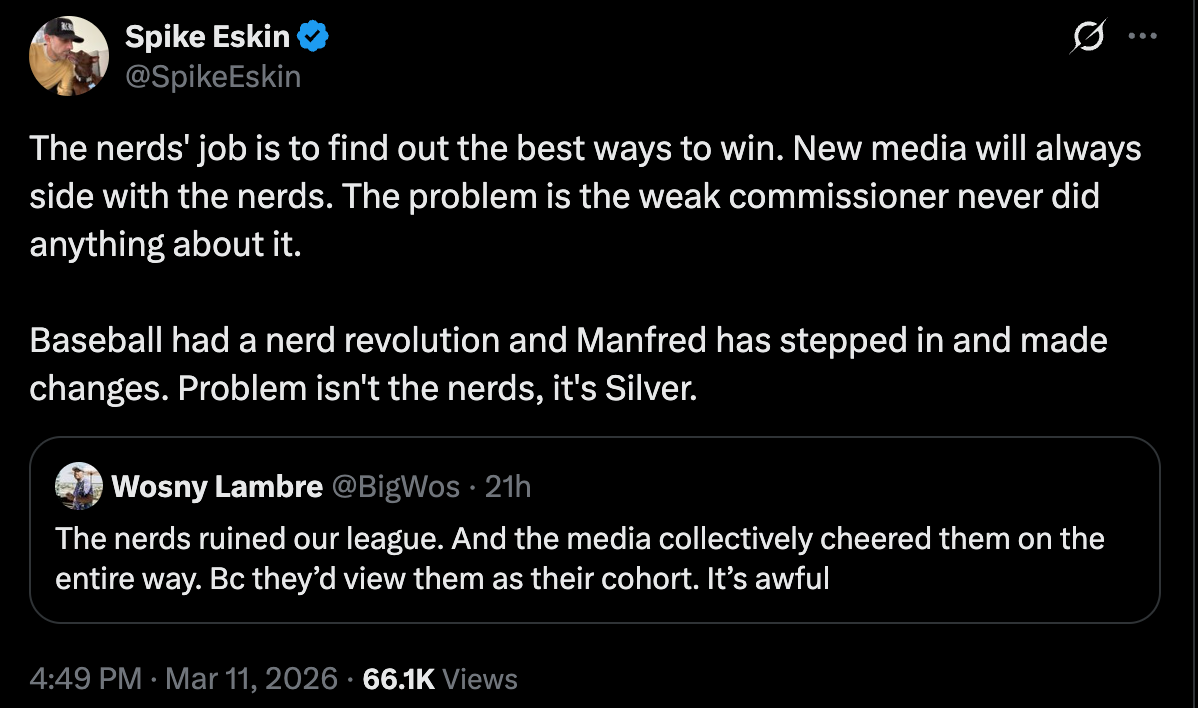
Here’s what I’d add. It’s not just the stereotypical nerds who brought us to this point. It’s also the players, playing like nerds. I say it more descriptively than pejoratively. And none of what we now hate is necessarily the fault of the aforementioned. I’ll get into what I mean later on in the article.
As Spike suggests, the nerds are going to look for ways to ruin all our favorite sports. I can relate to the destructive impulse.
Back when I played video games, I was always on the hunt for glitches and loopholes. My Madden past isn’t necessarily relevant to professional leagues but I cite it as an example of how a nerd’s pursuit of victory can be almost orthogonal to playing a game. I’m not “good” at video games on a pure skill level. I just have a relentless obsession with finding market inefficiencies.
One summer, my friends and I drafted our own Madden teams, in addition to creating our own plays. I took the fastest two cornerbacks but never dropped them into coverage. Instead I had Champ Bailey and some lesser speed demon line up out wide like edge rushers. In real life, an offense could account for the same two smallish fast guys, repeatedly rushing. In a mid aughts video game, there was no recourse. On any play action fake the quarterback was getting hit immediately. On any rush, the running back was getting contacted before the line. Cheat code Michael Vick? He had no chance outside the pocket.
So, through devising this plan, did I prove to be “good” at Madden? Not really. My success was automated and my friends were justifiably livid. They stopped playing me with created lineups and life moved on. I’d broken no rule, but certainly violated the spirit of our competition. But I, a nerd, saw no violation, at least back then.
What I’m saying is, there’s a platonic ideal of a play, divorced from success optimization. In the old NBA of my youth, “optimal” was a good shot. “Good” meant “close” and “good” meant “open.” It was acceptable and sometimes even preferable to shoot a 3-pointer, provided you were open. Little did we know that, once role players got proficient enough at launching contested 3s, it would be mathematically savvy for a team to hoist a whole lot of “bad” shots. Skill had unlocked the glitch, so in a way teams got “better,” but they’d gotten better in a way that had totally disrupted the assumed balance of the sport.
Most of us watch to see some combination of talent and chemistry in a sport with which we are familiar. We are not watching to see victory according to a form of basketball arbitrage. I’m impressed with Joe Mazzulla and the Boston Celtics, a team that indeed does have talent and chemistry. I also don’t believe their strategy of chucking “bad” 3s to avoid turnovers constitutes game play according to basketball’s spirit. Yes, I know there’s a lot more to the Celtics than what used to look like thoughtless gunning, but I invoke them just to say that “smart play” now appears less like intricately unpredictable strategy than repeatedly exploiting a Madden glitch.
The old NBA worked according to an unspoken assumption that nobody sought “bad” shots. Teams tried to get good shots, but if a guy was on fire, he might “heat check” some tough ones. Were the games pretty? Not by our current standards, but we didn’t know any better. Back when we were living in the archaic past, it felt a lot like living in the modern present.
Here’s how the game progressed, or declined, depending on perspective. The San Antonio Spurs optimized by taking advantage of the short corner 3. They’d found a loophole, but its exploitation was no aesthetic detriment. The Spurs had been a boring post play + defense champion, but as they hunted more 3-pointers, San Antonio became a “pass up a good shot for a great shot” emblem of inspiring unselfishness. You could call the D’Antoni Suns “optimizers” for pioneering “pace and space” but they were especially fun to watch thanks to Steve Nash’s creativity. Steph Curry’s off the dribble 3-point skill broke decades of established defensive assumptions and that spectacle was especially grand. What I’m saying is, many steps towards the horrid NBA devolution also happened to once be the glorious NBA evolution.
The Dawn of Hardenism
These teams were all critical smashes, but as often happens, the charismatic inspire plenty of less loved imitations. It was a lot more fun to watch D’Antoni coach Nash than to behold James Harden’s brand of chiseling in that same system. I understand Harden to be a basketball genius, but so much of his focus has been on exploiting a literalist interpretation of rules. When Harden intentionally swooped his hands under arms, it was a reach in foul on the defense. When Harden traveled, it was instead a manipulation of the “gather step.” When Harden pushed off, it was actually a legal “shoulder bump.”
It’s not Harden’s fault necessarily that Hardenism spread, but it indeed has. These dark arts rapidly proliferated in the information age. Players became experts in not just how to play “basketball,” but how to cheat in a way that’s not technically cheating. In summary, the jocks started playing like nerds.
The spread of basketball nerdom has gone on too long because the league is run too nerdily. What I mean is, Adam Silver’s NBA is so squeamishly deferential to rules as to submit authority to them. In the old NBA, a veteran ref like Joey Crawford had plenary power to call games according to his view of basketball. Players had to respect the whistle, and maybe stop flopping if Joey was sick of it. Now, with standardization pressure coming from legalized gambling, every morsel of the sport must be legislated according to the book. Lengthy replay reviews have been added just in case human “error” takes place. Players have taken so much advantage of Rule Authority that a lot of the modern game now can be construed as legal cheating. When only the “rules” are in charge, then nobody truly is.
So what we’re often talking about, when complaining about the NBA, is how to restore order. The only way for the game to retain its recognizable shape is through an accountable authority who is committed to that end. Knowledge can’t be unlearned and players can’t be made worse at shooting three-pointers. They can, however, be incentivized to play basketball in a manner that looks like basketball. Flopping can be punished. Physical perimeter defense can be rewarded. Traveling can be called more sanely. Tanking can be stopped. Reform is not an impossibility. It’s mostly a matter of will.
It’s less that nerds ruined the NBA and more that the sport was abandoned to the edge seeking nerds. A neglected game is an exploited game. As Spike Eskin referenced, baseball teams placed a million infielders on one side of the field because it’s smart. But letting that continue? That would have been rather dumb. Authority, be it through commissioner or ref discretion, is the antidote to Rule by Nerd, which is just another way of saying “Rule by Rules.”
The game lacks the variety that once made it so interesting. For instance, the pass-first point guard and the back-to-the-basket center have gone the way of the dinosaur.
Would the present-day NBA have any use for Isiah Thomas or Patrick Ewing? The evolution of the game has deleted entire classes of players.
The issues run deeper than the nerds. For a while, analytics made the game more visually pleasing and more enjoyable to watch, but then too much of a good thing seems to have pushed us past a point of equilibrium.
Every sport struggles or has struggled with this, but the NBA is clearly at an inflection point. The question: Is Adam Silver the right guy to fix it? Maybe he needs his own Theo Epstein.
I agree with most of this, but a missing piece is that games are just not properly officiated. Players exploit gray areas (the Harden example) but also blatantly break straightforward rules on a nightly basis and get away with it. If a guy doesn’t inbound the ball in time, that’s against the rules. If it doesn’t get whistled, that’s not taking advantage of loopholes; it’s the refs not doing their jobs. I understand the reluctance - it’s a star-driven league, and whistling a superstar for a travel or a lane violation or some other small thing makes him look like a dumbass, which hurts his brand image. It doesn’t have to be that way - even though both leagues are rife with preferential calls, I still think there’s a big difference between the NBA and NFL when it comes to brutal technicalities being enforced. At least once during football season we’ll see a walkoff touchdown called back because the player dropped the ball before crossing the goal line. When’s the last time you saw a breakaway dunk get waved off because Giannis took four steps after the dribble? That shit would NEVER happen. Well… maybe it should, Mr. Silver. If even the non-subjective calls get deliberately botched, it just feeds another layer of distrust and exasperation on an increasingly loosey-goosey product.