

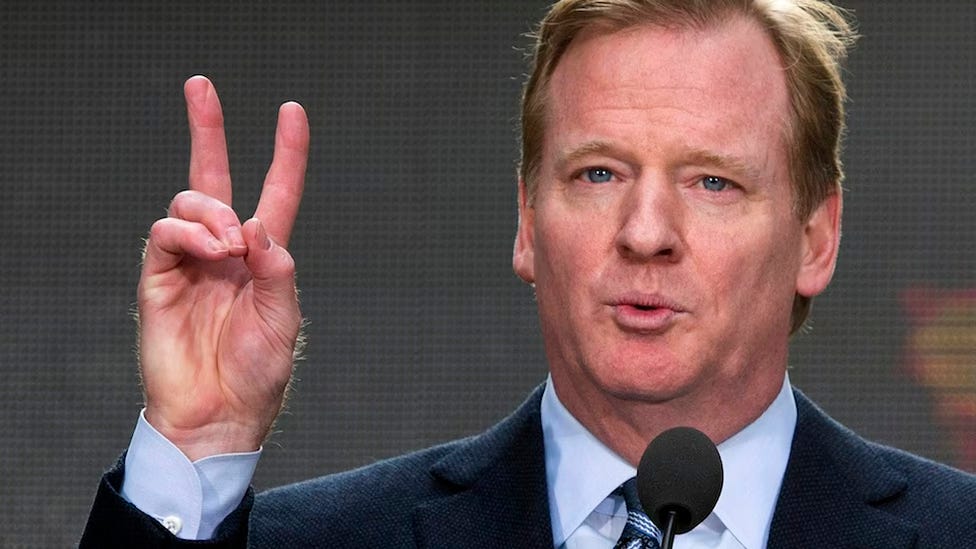
The TV Grim Reaper account tracks the decline of the traditional television media ecosystem, often in ways that contradict more access-driven publications. The Reaper has called his shot on the following take: NFL commissioner Roger Goodell massively screwed up his TV rights negotiations.
Epic failure by Goodell. Tremendously overplayed his hand.
What’s especially intriguing about this story is that Goodell was inspired to chase a higher price for the NFL because NBA commissioner Adam Silver had recently achieved an impressive one. I’ve criticized the NBA commish for years, but right now it’s undeniable: He’s flying high, as his counterparts in other leagues are suffering struggles. Here’s why Adam Silver won and Roger Goodell lost.
Quoting Alex Sherman of CNBC in an article titled “Fox won’t renegotiate NFL media rights before current deal expires, CEO Lachlan Murdoch says”:
NFL Commissioner Roger Goodell told CNBC last year he felt the league’s rights were relatively undervalued compared with other sports. The NBA nearly tripled its media rights revenue with an 11-year, $77 billion deal struck in 2024.
The NFL signed its most recent media rights deal, worth more than $100 billion, in 2021.
Adam’s 2024 negotiation triumph put NBA rights at 69 percent of what the NFL hauls in annually. That was an incredible coup. Sure, basketball has more games than football, but this is football we’re talking about. Every week, the NFL airs multiple matchups that would constitute a historically high NBA Finals viewership number. Roger Goodell owns the Super Bowl, for God’s sake. His league stole Christmas, the NBA’s premier regular season event. There are years in which over 90 of the top 100 most watched events are NFL games.
When the NFL renewed in 2021, that put the NBA at 26 percent of the NFL haul. Before the NFL did the 2021 contract, the NBA was at 59 percent of the NFL take. Now NFL rights cost only about 1.6 times that of NBA rights. In 2024, basketball somehow gained relative to football despite a decade of stark viewership decline, immediately following a lackluster Finals. Given the situation, I’d say that Adam had one hand tied behind his back but still managed to poke Roger in the eye.
In response, like Stephen Jackson on Don Nelson’s Warriors, Goodell attempted to renegotiate himself a better deal, mid-contract. His league has “opt-out clauses after the 2029-30 season for all media partners except Disney, which has one extra year of rights,” but Roger wanted to get an even faster jump on improving his sport’s station.
From a September interview of Goodell, conducted by aforementioned Sherman:
“The reason why we felt so strongly about the option is the landscape is changing. It could be a long-term deal with the benefit of having that stability and security of it. But I think the reality of it is it changes so quickly that you want to have the ability to move. I think those options are going to give us a lot of flexibility to potentially go earlier,” said Goodell.
Other major professional leagues, such as the NBA and NHL, have dramatically increased their TV revenue in the last year by striking new deals with media partners. Goodell admitted to watching other recent sports’ media deals and said, in comparison, the NFL is leaving money on the table.
Football makes the most money, obviously, but on a relative basis, their deals now look significantly underpriced. Surely the NFL-hungry networks would agree to remedy this situation. Right? Wrong, apparently. Lachlan Murdoch was steadfast on Thursday:
In advance of the season, we’ve had a recent thorough and productive discussions with the league, and as a result, we will not be making any amendments to our existing contractual relationship, which extends to the completion of the 2029 season. We’ll be ready to engage with the NFL on the opt-out seasons and beyond at a date closer to the 2030 season, which has been the customary timetable.
There’s a lot going on right now, including and especially Paramount Skydance (CBS) merger machinations. Paramount Skydance CEO David Ellison is in a protracted antitrust battle, which hinders his short term flexibility, and he’s also gobbled up Turner sports assets, reducing the potential for chaos in the sports TV ecosystem. Meanwhile, streamers look a little less hungry for sports these days. Quoting Sportico:
With the cable threat now neutralized—and given that the penetration of the pay-TV bundle has fallen to 33% of all U.S. TV households, that avenue is now closed off forever—the streamers represent the sole clear and present danger to the legacy NFL partners. And that danger remains somewhat overstated. Its $303.6 billion market cap aside, Netflix never tires of banging on about how it is only interested in “eventizing” sports a la its annual Christmas Day NFL presentation, and YouTube recently spit the bit when the league intimated that it would be asked to share the repurposed ESPN inventory with Ted Sarandos & Co.
Netflix has seen its stock plunge, and is weaker. Amazon wants more NFL inventory, but as holders of Thursday Night Football, they don’t represent an entirely new player in this game. I’m not saying that Adam Silver caught the last helicopter out of Streamer Saigon, because this industry is difficult to predict, but his timing looks impeccable.
The AI Issue
Sports leagues looked to the streamers as this deus ex machina solution to their financial ambitions, but one potential snag is that tech companies recently gained their own deus ex machina to obsess over: The AI arms race. For example, NFL rights holder YouTube/Google now has massive AI-related expenses to manage. For all large companies, AI capex is quite the drain.
If you’re a Big Tech company in 2026, what makes more sense: Devoting your resources to AI development, or to broadcasting sports? Imagine losing the most important technological battle ever because you wanted to own Titans-Browns.
Adam Silver wrapped up his negotiations just before the AI arms race reached critical mass financially. Roger Goodell boasts America’s favorite entertainment product, but his timing sucks. Buyers will eventually pay handsomely for NFL rights, but as powerful as football is, it can’t bully everyone. Leverage is as much related to the world around you as it is how dominant you are in your world.
"Imagine losing the most important technological battle ever because you wanted to own Titans-Browns."
This almost caused the coffee through my nose this morning!
It’s pretty funny that the AI bubble is now crowding out the sports broadcast rights bubble.