

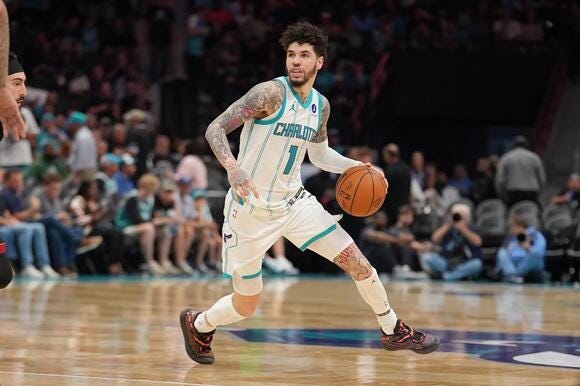
The NBA regular season is over, instantly making the NBA more charismatic. The Play-In games on Tuesday night were exciting, reminding many of why their default setting is to love America’s most aesthetically appealing sport.
Bob Myers’ greatest contribution to the NBA is obviously his general management of the dynastic Golden State Warriors, but his greatest contribution to understanding the NBA came from a riff about the playoffs at the MIT Sloan Conference. I happen to love this clip that regularly circulates around this time of year. Bob begins his spiel with:
The playoffs are nothing like the regular season. They are two completely different sports.
The speech isn’t conveyed with flair, but it’s just so naturalistic, honest, and validated by the presence of Paul Pierce at the podium. It’s confirmation of what we all might sense or assume. Players are locked in, teams are locked in, which meaningfully alters the product. This is what trying looks like, and in that atmosphere certain normally productive one dimensional players become liabilities. It’s a different game, a harder game.
This isn’t mythology, of course. There’s a wealth of statistical data that demonstrates the NBA playoffs to be slower and offensively less efficient than the regular season. In light of that, I found the reaction to play-in games interesting. Many welcomed the shock of an NBA experience so unlike the preceding last few months.
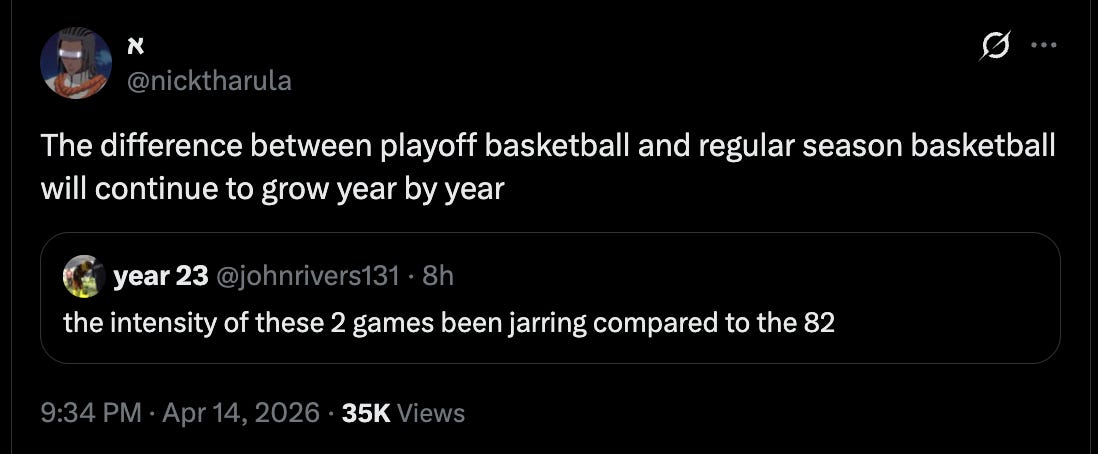
As an experience, the games clearly felt different. The crowds were more involved, the players more emotional and guys who might be hurt were gutting out minutes (Moussa Diabaté).
In terms of superficial style, though, the play-ins were more or less in accordance with offensive regular season NBA norms, with pace slowed down to 2016 regular season levels. The Hornets and Heat combined for 97 3-pointers in their overtime thriller, a barely noteworthy fact that probably leads SportsCenter if it happened a decade ago. Deni Avdija was amazing, but I wouldn’t say the same for the defense he faced from Phoenix at the rim. In summary, Tuesday night looked a lot like the NBA that so many people now hate, just a bit slower, only this time everybody seemed to love it.
I mention this not to criticize the play-in games, which were great, but to ask how much of the NBA’s issues, such as they are, are actually related to stylistic shifts in the sport. I’ve discussed how the game has moved away from a platonic ideal. I share Spike Eskin’s idea that you can diagnose league problems by simply asking fans for their opinions, but my unprovable assumption is 1) Many fans would complain about all the 3-point jacking with impotent defense and 2) Many fans would agree that those two games were awesome.
So what do we love about basketball with stakes? Is it the balky, disrupted product Bob Myers describes? I certainly prefer that mode, and I suspect the slightly lower pace on Tuesday was appreciated. But, obviously, what’s more important is the stakes themselves. One lesson I take from Tuesday is that, much as points and pace inflation might be an issue for the league, it’s perhaps minor compared to a broader sense that a game doesn’t matter. The star of the show in both games was the motivated crowd itself. The main prerogative for the league going forward, if it’s to improve the regular season, is to somehow return a sense that the outcome is of significance. How the game happens matters, but what matters most is that it matters.
People think the regular season games don’t matter because of availability of players compared to previous eras. There’s a few things that feed into that notion in the mind of fans: 1) more access to games and coverage than ever before. Anything that happens with the league is covered granularly, while in past times, many stories remained localized. 2) pace and space era has accelerated star injuries and the need to sit players, which makes fans think the regular season doesn’t matter (especially when guys sit out national tv games). 3) Quants run teams now, so when the math says a team should run more to win (even if it pace and space is making players more injury susceptible), they do it. If the math says a player should sit for potential injury risk or that a team should blatantly tank the year out to secure a better place in a talented draft, that’s what is gonna happen. Zero consideration for how it will impact perception of the league. But I don’t blame the quants for that as much as the league for not preventing this from becoming the bible of the nba.
Crazy idea, but the league could just shift the makeup of the regular season by boosting the share of intra-conference games and (more importantly) divisional games. This means less cross-country travel and healthier regional rivalries. Players get more time with their families, more time to rehab, healthier sleep, etc. I’d love to see divisions actually mean something like they do in the NFL, whether it means altering the playoff format or giving some postseason benefit to winning your division. Yes, there’d be the downside that certain WC and EC teams wouldn’t play each other every year, but honestly who cares? You can’t see Jaylen Brown match up with Deni Avdija one season? Just wait for the next. Years go by in the NFL without certain matchups, and no one loses sleep. It just boggles my mind that this hasn’t seriously been floated as a solution - it doesn’t even require changing the number of regular season games!