

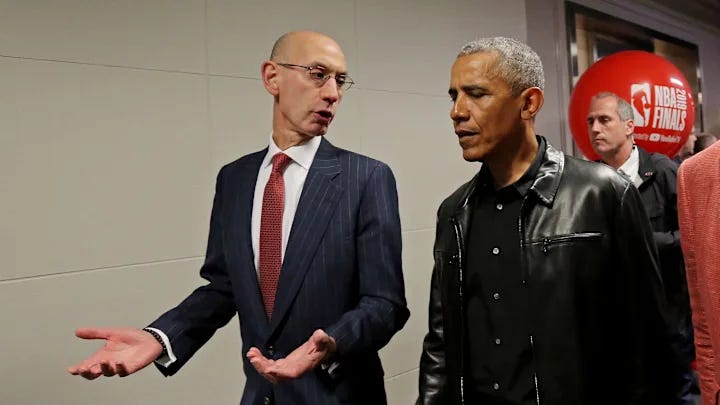
At House of Strauss we try to catch some items that you otherwise might miss. For example, there’s a big Adam Silver hit piece that’s paywalled and presented with a positive-sounding title. I was shocked by its contents.
It’s a profile of Silver in The Atlantic by Tim Alberta. The article, “ADAM SILVER GOES TO WAR,” includes an interview with the NBA commissioner. Given that the playoffs are happening, the commissioner participated, and the label conveys a flattering “man of action” portrayal, I assumed this was a puff piece. I mean, Silver has been popular for years with this cohort of people who write articles for prestige magazines. What else could this be?
But despite Silver’s participation, and maybe in part because of how that participation happens, the article is withering. I wonder if it surprised the NBA like it did me. Sure, I perceive Adam Silver as an uncertain man who’s terrified to lead, but I didn’t expect to read that take in a glossy mainstream publication. A couple quotes that initially frame its subject.
The commissioner is carefully stage-managed. Media engagements are rare; rarer still are the probing questions that might be asked of someone leading a business valued at roughly $200 billion.
This is true. Unlike predecessor David Stern, Silver is averse to any potentially confrontational setting.
I had been warned, when talking with his contemporaries, that Silver is kept in bubble wrap
I believe the NBA erred in stiff-arming Tim Alberta and The Atlantic. I don’t believe they took kindly to being treated like Outkick the Coverage.
Silver’s longtime flack, Mike Bass, was refusing to answer my texts—we stood 50 feet apart, separated by the VIP rope, as he stared at his phone—asking for an introduction. Meanwhile, officials from three separate teams, whom I’d planned to meet in Nashville, had all canceled. It seemed like a coordinated snubbing. Which left me no choice: When Silver wandered within reach, I slipped the rope and thrust an open hand in his direction. The commissioner, who is six-foot-three and wears a clean-shaven head, studied my name tag—The Atlantic—and then spun toward Bass, who looked exasperated. Silver’s complexion turned colorless, almost ethereal, as he shook my hand. I assured him that there was nothing to fear, that I’d tracked him to Tennessee because I wanted a proper interview.
“That’s up to Mike,” Silver said, glancing at his spokesman.
“C’mon,” I replied with a grin. “You’re the commissioner.”
Silver was expressionless. “Sorry, it’s not my call,” he said. Then Bass hustled him away.
I’m reminded of how Silver delegates the duty of punishing players to teams rather than just own what he wants done. Why not just be an adult and do or don’t do an interview? Why pretend that Mike Bass is in charge of what you, the NBA commissioner, decide?
The whole thing felt a bit pathetic. As a sports junkie, I’d always imagined commissioners as party bosses: indomitable, shank-wielding enforcers who win by any means necessary. Silver is not that guy.
He really isn’t. The (eventually secured) interview validates that portrayal.
He begins and ends his days with media briefings, but he also spends plenty of the intervening hours scrolling “NBA Twitter,” studying complaints and critiques the way a stockbroker monitors movement in the S&P 500. It’s an unhealthy habit. Silver finally married in 2015, at age 53; one person close to him told me that league employees, worn out by the commissioner’s neurotic disposition, rejoiced when his two daughters were born.
Silver does not dispute such portrayals. “There’s a lot coming at us all the time, and I think there’s plenty to be nervous about,” he said. “I think maintaining a state of mild paranoia is necessary.”
I don’t want to paint too bleak a picture of the league at the moment I’m enjoying playoff games, but if you want to diagnose its main problem, it’s all right there. The NBA commissioner is nervously mainlining NBA Twitter, trapped in a perpetual state of social media present shock. I don’t understand how you can sanely run a league if this is your main input.
I’d recommend the entire article, which includes reporting on how the NBA discovered the downside of offense at all costs.
After league officials gave a presentation, sharing metrics to demonstrate the scoring binge and the dissatisfaction of NBA viewers, Mike Krzyzewski spoke up.
“You know,” said the legendary Duke coach, who’d recently joined the league as an adviser, “fans like defense too.”
Silver described this comment—and the meeting itself—as a sort of road-to-Damascus revelation.
“We weren’t, I think, appropriately responding to the perception that we had let it go too far,” Silver told me. He later added, “To the extent that we were overly limiting on players’ ability to be physical on defense, I think that led to the perception in many cases that they were not as passionate about winning as they were in the old days.”
I’m happy that the NBA eventually came to this realization, but look at how the lesson is framed. Silver says his league wasn’t “appropriately responding to the perception” that it had allowed offense to go too far. But it wasn’t a “perception.” It was just a reality that scoring had boomed beyond modern precedent. Any fan of the game could have told you that 145-135 games aren’t appealing on a nightly basis. We weren’t all tricked by some “perception” meme. Why can’t an outcome just be wrong according to how the sport is played? Mike Krzyzewski and Steve Kerr hated what happened to the game because they love the game. These legendary coaches didn’t hate what happened because they fell prey to a “perception in many cases that players were not as passionate about winning as they were in the old days.”
For years, the NBA has been protected from such critical media analysis due to, let’s face it, politics. Donald Trump went to war with LeBron James, and the mostly Black league attained this archetypal WOKE branding in conservative spaces. Adam Silver played into that progressive image when it was considered more fashionable, moving an All-Star Game from Charlotte in 2017 due to North Carolina’s bathroom bill. This decision, along with his expulsion of Donald Sterling when he took over in 2014, made Silver a hero to the sorts of people who write Atlantic articles. During the early days of Trump Term 1, you’d never read a portrayal of the NBA commissioner as feckless. Back then, he was the model of strong, morally-focused leadership.
When the NBA began to lose popularity, it was considered in media as conservative-coded to observe that. Perhaps you’d see negative data points in a disgusting fascist rag like House of Strauss, but not so much at the New York Times. The publications of prestige were more likely to fight back against this “narrative” rather than concede a reality that could validate a Trump voter. But there’s an expiration date on grace. Liberal journalists are starting to discover that, despite the NBA securing its 76 billion TV rights deal, all is not right with the product. All the Adobe Analytics viewership juicing in the world won’t move them off that take, either.
My theory is that Pablo Torre’s Steve Ballmer investigation represents the starter pistol for this broader admission in liberal prestige journo world. From Alberta:
This season has demonstrated that the threats are real—and they are multiplying. Teams lost countless games on purpose in the pursuit of better draft positioning. Players—and, even more troubling, a head coach—were caught up in gambling-related scandals. The NBA’s wealthiest owner, former Microsoft CEO Steve Ballmer, who bought the Clippers after the Sterling fiasco, was accused of funneling payments to his franchise player via a third party to circumvent the salary cap, an allegation that continues to shake the foundations of the league. (Ballmer has denied any wrongdoing; the investigative journalist Pablo Torre’s podcast, which exposed the alleged cheating, was recently awarded a Pulitzer Prize.)
Pablo is of the left, went to Harvard and won a Pulitzer for NBA-critical reporting. His war on Ballmer represents and accelerates a sea change within prestige media. I’m not suggesting that Tim Alberta waited for Pablo to gain status from an investigation before deciding that he too had NBA issues. I am saying there’s an industry impact downstream of a liberal journalist winning a Pulitzer for making Adam Silver’s life hell.
Not everything is politics, even though the NBA received a lot of soft coverage due to a political proxy war. I am aware that Tim Alberta wrote American Carnage: On the Front Lines of the Republican Civil War and the Rise of President Trump, but I do not know the particularities of his political opinions. I do know this, though, from reading his article: Alberta is a diehard NBA fan and has been for decades. He’s disenchanted at the moment, as many other basketball lovers are.
There are many liberal NBA fans who hold strong opinions about the league, divorced from ideology. They’ve sensed that something is rotten in the state of Denmark for some time, even if their preferred publications wished to ignore it. Politics protected the NBA for a spell with this cohort. That can only last so long, though. Eventually, regardless of voting track record, people who love the game will turn on those they see as undermining it.
Pulitzers impress no one outside the soon to be extinct newspaper people. And some of the winners turn out to be spectacularly wrong.
There was a time when I could name almost every played on every roster. These days, there are entire starting fives on the worst teams who names I don’t recognize. I don’t think I’ll be renewing my NBA League Pass this next season.