

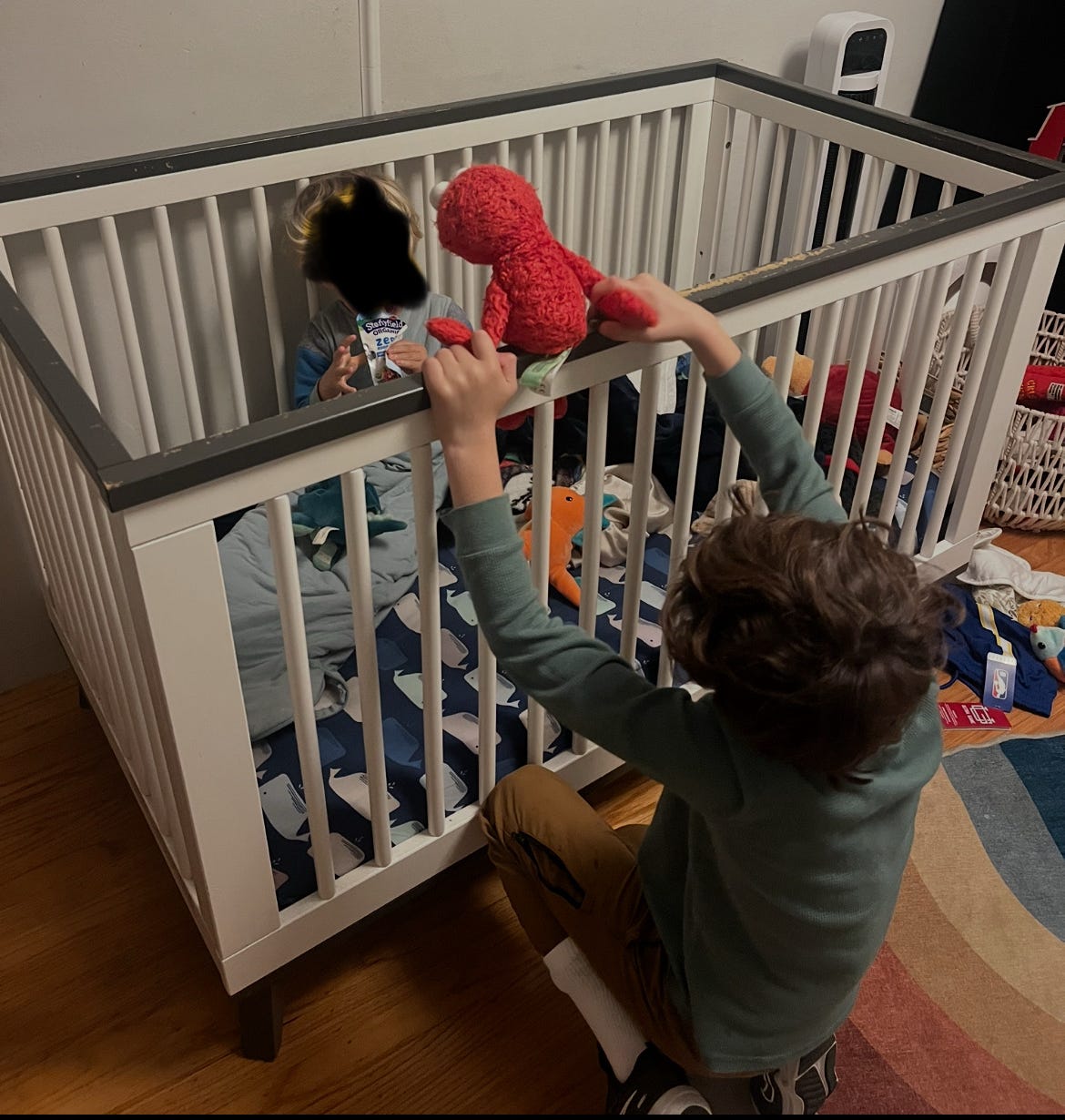
Coming off the Thanksgiving weekend, I’m thinking a lot about family and gratitude.
I’m wary of writing about my family, for a lot of reasons. I’m not famous, but any bit of exposure you give your loved ones on the Internet feels precarious. I also have regrets over writing about my father, back in my 20’s, when I carried more angst regarding our relationship. He’s a good guy, and like 99 percent of people, didn’t deserve the indignity of being blogged about.
Beyond that, I don’t want to be seen as someone who’s cynically using my family. I suppose I should say that I don’t want to cynically use my family, but I’m vainly more haunted by the prospect of the appearance. I well remember when Freddie deBoer expertly skewered Drew Magary for doing so:
The totally bizarre condition in media today is that I’m expected to just golf clap and say “I respect your journey” to someone like Magary even when it’s utterly clear he’s just another cynical opportunist, trying to find a new way to pay off the mortgage now that he can’t publish more books that amount to picking his children up by the ankles and shaking dimes out of their pockets.
I laughed and winced when I read that, “picking his children up by the ankles and shaking dimes out of their pockets” line. Freddie deBoer really captured something that I’d sensed without articulating. There’s a thin line between honest vulnerability and making your personal life into a form of clownish fodder.
At the same time, I occasionally feel a need to publicly process what I’ve experienced in private. What I do isn’t exactly me, but it’s related. I also believe there’s a value in expressing a condition that others encounter. For over two years, I feel as though I’ve carried this secret about my family and how our lives took an unexpected turn. If you don’t mind, I’d prefer to think through this, out loud.
My younger son is autistic and that reality, more than the diagnosis, has greatly impacted my wife and me. He’s very sweet, but I can’t really communicate with him, at least not in the way other parents usually can with their kids at this age. It’s changed me. It’s changed us. It’s torn me down and opened me up. I tried to face it all stoically, only to buckle. I’m just not very stoic about this I guess.
My boy loves music, for which I am grateful. When I arrive to pick him up, he often runs over to me with a smile. Other times, he’s either lost in his own world, or is completely locked in on a need. Instead of stating what he wants he’ll grab an object, or take my hand to drag me there. The latter is called “hand leading,” and it’s a symptom of autism. In a way, it’s both more and less intimate than standard conversation. We can’t exchange thoughts, but while struggling to connect, we’ve got touch. It hurts that my little guy can’t clearly tell me what’s on his mind, but I’ve come to treasure the tactile sense of his soft fingers, physically tugging me towards his mind.
You tell people your kid is autistic and they often respond with positive stories of children who later led independent lives. It’s difficult to know how to feel about these tales because the condition is such a capacious “spectrum.” My child is autistic-autistic. Until further notice, he’s not the “quirky, but good at math,” kind. He’s the “flaps his arms and makes noises instead of words” kind. Communication can happen, but is often orthogonal to what you’d expect. He loves Elmo, but never says “Elmo.” Instead, Elmo is “La La,” because those are the main words in, “Elmo’s Song.” I think, and this is only a guess, the label of what something is happens to be categorized as what something does. I can hazard other theories, but much of how my boy processes the universe remains a mystery.
I love him, but I don’t know what to expect for him. One difficulty of this situation is that you’re not only coping with it but also grappling with the unknown. If we understood exactly what this was, we could perhaps more easily move beyond what is, admittedly, grief. We’ve suffered what feels like a loss, but aren’t sure of its magnitude. We’re told that, in due time, it might look like we’ve suffered nothing at all. We know what to hope for, but should we hope at all?
You can tell us to be grateful for him and we are, but we will still feel all of this soft grief, at least at this stage. And we will feel it in part because we are so grateful for him. Our love for what we have is tethered to pain over what we lack. Presently, we are not sure if we’ll be taking care of him until we pass on, or if he’ll some day manage to be the one taking care of us. I pray for the latter, but wonder if I should, for the sake of sanity, assume the former.
The idea of the former hurts a lot, especially at first. The majority of parents want kids who succeed and exceed them. Beyond everything else they mean to us, they can be vessels for our ego. We have hopes and dreams for them, even if unspoken. For most people, there’s a status anxiety to parenting that seeps in, even if you reject the premise. My neighborhood is replete with high achievers who’ve learned to feign indifference over achievement. But the heart wants what it wants. Nearly everyone is sensitive to whether their kids are falling behind, keeping pace, or speeding past the others in some capacity. You can say, “all I want is for my kids to be happy,” and even mean that when it’s spoken, but there’s a reason parents are so often “proud.”
It’s embarrassing to admit, but my ego took a hit from this experience. I was proud of having a sweet child that others fawned over. In due time, I’d get antsy at social functions where an older woman would start talking to my son and get confused about the lack of response. Does she notice something’s wrong? Is anyone else keying in on how the smaller children are more advanced? Is everyone else here thinking about it? I’d sense a need to intervene and let the old lady know about our thing, this thing, whatever it is. She’d then try and make me feel better about it with some story about a nephew. It’s a noble impulse but not exactly what I want. I mostly just want to stop noticing everything the similarly aged children can do that my son can’t.
I’m getting better at ignoring those discrepancies. The transition is from wanting a child to validate a sense of yourself to conceiving of yourself as merely serving the child. It’s easier said than done, but gets easier by the day.
Life has gotten better since our first “something’s wrong” meeting at the hospital, and yet part of us remains stuck in that moment. I don’t remember much about what the doctor specifically said but it pertained to where other kids are typically at and it was devastating. When you get that kind of life changing news, the physical sensations take over. My main recollection is stumbling out of Kaiser hospital, into an afternoon light that felt blinding. Suddenly our whole reality was altered and my stomach was twisted up. For a long time, I’d had a “perfect” baby, one who easily drew cooing compliments from strangers at the grocery store. Now he wasn’t like the others. Now our lives weren’t according to plan.
There’s the dark thought of, if he can’t make it on his own, who’s going to take care of him after we’re gone? He’s so joyful, so innocent and we’re the only ones who care enough to give him what he needs in perpetuity. I love him differently from my other loved ones, in part because he’s so vulnerable, maybe forever. He’s not to be counted on as a provider to others. He’s someone who requires help in our big, indifferent world.
There’s this scene in the wonderful Planet Earth series Dynasties where a baby penguin is lost alone, in a snowstorm. The chick chirps desperately for aid, struggling to break through the white wall of wind. He can’t be heard above the din, much as he yells. The chick eventually gets saved, but certainly others weren’t. Incidentally, the film crew controversially intervened to save a few of the ones that were surely doomed. The image and noise has repeatedly flashed through my mind over the past two years. “That’s him without us,” I think. I would hope his older brother helps going forward, but that’s a lot of future pressure to put on an elementary school kid.
Thankfully, we are not penguins. We have a society, and there are services available for child like mine. My wife has done an incredible job discovering what he needs and how to get it. Additionally, and perhaps this is cliche but it’s cliche for a reason, the tough times reveal beautiful qualities in family members. Once you drop the stoic act and admit you’re actually struggling, you open yourself up to others in a way that otherwise would never have happened. I feel closer to my immediate and extended family now than I did two years ago.
Before I could pretend to be very independent. Modernity indulges this fantasy. You’re an adult and everything is on demand. Then life stops going according to plan, as it does for us all, and you realize how little of what matters can actually be authored. The attached realization is how much of what matters connects to the comfort and assistance provided by the few people on earth who’d meaningfully sacrifice for you. I can’t tell if I’m weaker now than I once was, or just more clued into how life can’t be overcome with my strength.
Meanwhile my youngest doesn’t know or care about any of this. He’s happy, often giggling as he plays throughout the day. He isn’t aware that I and my wife are always worrying about him. He’s oblivious to the sacrifices grandparents, aunts and uncles have made on his behalf. He’s in his own world, but it’s a good one. They helped make it better. I can’t be everything that he needs, but thankfully neither of us is isolated on this journey.
I love your Substack, but do not leave comments. However, today is the exception. Your piece was courageous and certainly not fodder. Thank you for sharing.
I’m a pediatrician and often see dads struggle with the complexity of the emotions you so eloquently describe. I’ll direct them here in the future. Thank you for sharing.